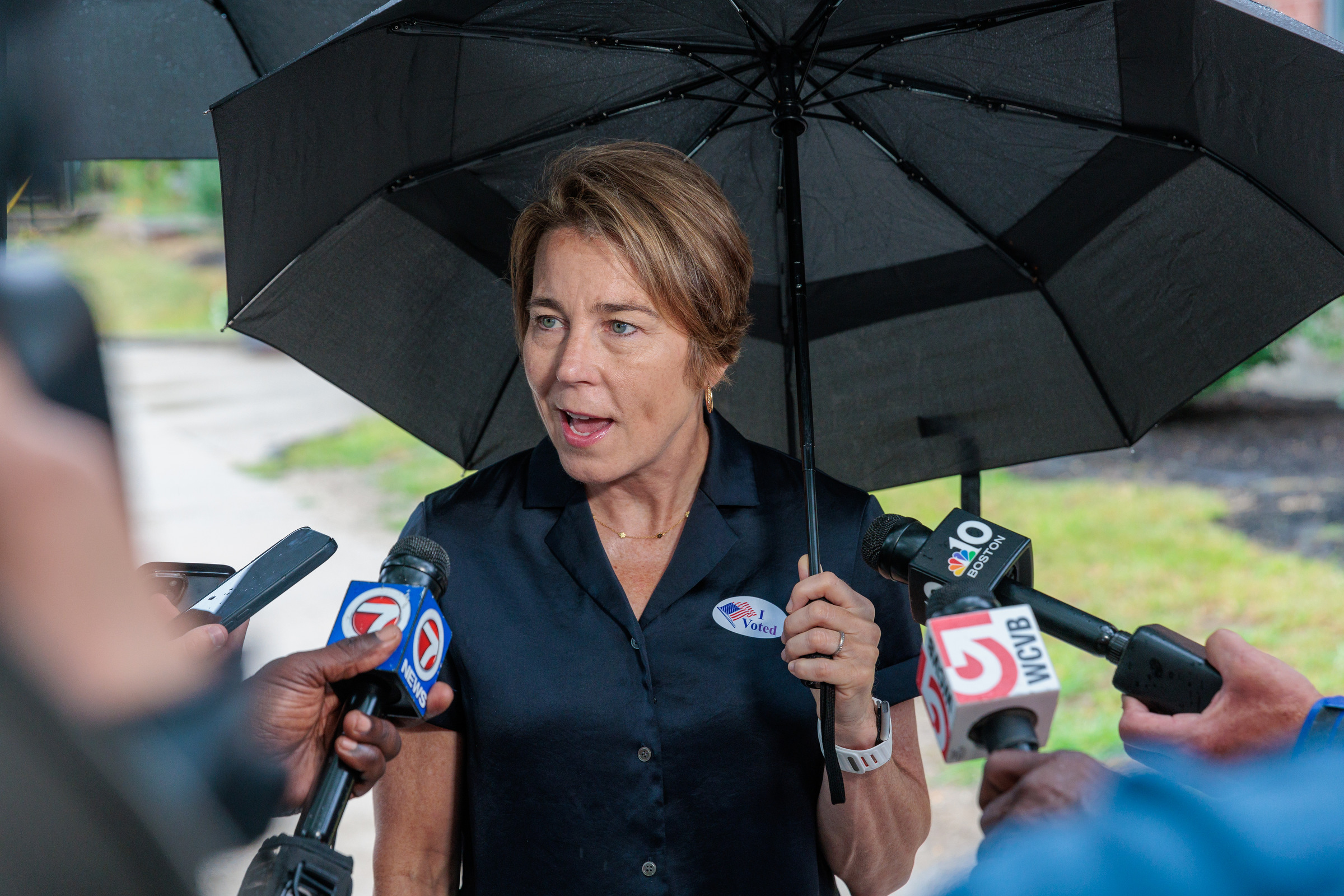
Gov. Maura Healey and Republican challenger Mike Minogue faced off in their second and final debate Thursday night, as both candidates made their case to voters for their visions of leading Massachusetts over the next four years.
Hosted by WCVB Channel 5, WBUR and The Boston Globe, Healey and Minogue sparred over affordability, federal immigration enforcement and government transparency, with Healey remaining steadfast in her stance against President Donald Trump and Minogue revisiting the shortfalls of Healey’s time on Beacon Hill.
Healey and Minogue will face off in the general election on Tuesday, Nov. 3. Polls will be open in all 21 Arlington precincts from 7 a.m. to 8 p.m.
Throughout the debate, Healey, a resident of Arlington, frequently tied Trump to rising costs in Massachusetts, arguing she is looking for every option to address concerns around the high cost of living in Massachusetts.
“Frankly, you know, there’s only so much that a governor can do in the face of devastating cuts by the federal administration to health, health care, to housing, to services for veterans, and more in the face of tariffs and in the face of taxes,” Healey said. “But I’m going to continue to look every which way to find ways to lower people’s costs on energy, on health care, and so much more.”
While Minogue prodded at Healey about her time as governor even before Trump took office, pressing her on why Massachusetts is still one of the most expensive states in the country.
“You had the job,” Minogue said. “You had President Biden for the first two years. You didn’t fix it then. You didn’t fix it in the last two.”
“I’ll work with whatever president is in office,” he continued. “Those things happened on your watch. You’re responsible.”
Cost of living, housing and energy
Throughout the debate, affordability took center stage as both candidates clashed over how they would make Massachusetts an affordable place to live.
“The first thing I did was cut taxes,” Healey said. “They weren’t tax cuts for the wealthy, [but] they were tax cuts for seniors and parents, and young people and small businesses.
At the same time, she also placed blame on Trump for rising costs across the state.
“But make no mistake about it, we’re only having this conversation because we’ve got a president who’s taken us to war, who long ago put on tariffs, and has done other things that have raised the cost of everything,” Healey said. “Americans across this country, including in Massachusetts, are paying the price.”
Minogue brought up Healey’s remarks from the candidates’ first debate last week that Massachusetts is a great place to live “if you can afford it.”
“That is the problem. People can’t afford it,” he argued.
Healey defended her administration, claiming she is “going to continue to work on affordability every single day.”
“I understand the challenges with costs, and that’s why I’ve been working to build homes as quickly as possible to lower costs, to lower health care costs by capping copays and deductibles and getting rid of prior authorizations, to bring in as much energy as possible so that we reduce people’s electric and gas bills,” she said.
For more affordable housing, the governor said “we’ve got to build our way through to lower costs,” pointing to a plan that she said reduces permitting from one year to 30 days and provides tax credits to developers in an effort to reduce housing costs.
Minogue made a case for a universal “stretch code” that would get rid of more stringent housing requirements, along with shortening the permitting time to build low-cost housing.
He also said he supports natural gas pipelines along with exploring nuclear energy to lower bills, and blamed Healey for the state’s high energy bills for stopping the construction of natural gas lines throughout the state during her time as attorney general.
“I’m trying to get as much energy in all different kinds into Massachusetts as quickly as possible,” Healey said in response. “In fact, I shrunk permitting times for energy infrastructure so that we can do it more quickly.”
Healey again turned her attention towards Washington when explaining why energy costs have been on the rise.
“People’s energy costs, [are] being driven up by a war that we shouldn’t be in and tariffs, all the result of Donald Trump, a man that my opponents supported and helped put in office,” she said.
Opting into the federal scholarship tax credit
The Education Freedom Tax Credit, included in last year’s One Big Beautiful Bill Act, provides a federal tax credit up to $1,700 per individual and up to $3,400 for married couples filing jointly who donate to nonprofits funding scholarships for eligible education expenses, such as private school tuition or tutoring.
Minogue urged Healey to opt into the federal scholarship tax credit during his opening remarks, and doubled down on his call for the governor to participate in the program when responding to Healey’s claim to have worked on providing affordable education by making community college free.
Healey didn’t directly respond on whether she would participate in the federal tax voucher, saying she thinks “we’re making the right investments.”
“I’ve invested in literacy, high-dose tutoring. I love vocational schools and career technical education,” she said. “That’s why, under my leadership, I’ve grown those by some 25,000 seats.”
Despite the governor’s praise, Minogue claimed the outcomes are worse, pointing to the 2026 MCAS results showing 60% of students not being proficient in reading and writing in both grammar and high school.
“Why do we care about community college when 60% of the high schoolers can’t read and write at a proficient level?” Minogue asked. “The first thing we have to do is give them the right education, give them vocational schools.”
“If you care about the communities that don’t have the zip code and the money, this is the way to help everyone,” Minogue added.
Reining in ICE
Healey highlighted her approval of the PROTECT Act in August, which limits local and state cooperation with federal civil immigration enforcement and prohibits most civil arrests without judicial approval in places such as schools, health care facilities and courthouses.
“I signed the Protect Act because of ICE, which is an out-of-control rogue agency that’s shooting at U.S. citizens, taking people out of our communities and off the streets who are simply taxpaying, raising families, contributing to our economy, and on their way to work,” Healey said. She claimed that ICE is “the public safety threat right now in our state.”
Yet she also said she is the first “to take violent criminals off the street, and if they’re not here legally, they should be deported.”
Minogue agreed that was an important point, but said the most important thing is to “lower the temperature” with ICE.
“Let’s not have ICE going into the communities without coordination and without privatization of the violent criminals and the drug dealers,” Minogue said. “It’s not compassionate either to release a criminal back in to terrorize an illegal immigrant that’s been here for 15 years, works, pays taxes, and goes to schools.”
“I would make sure that we target and cooperate with local, state, and federal authorities, so we truly can target the people who are terrorizing everyone in the community,” he said.
Transparency in the governor’s office
Minogue took aim at this week’s arrest of Healey’s former aide LaMar Cook on federal charges for fraudulently obtaining SNAP benefits along with a settlement with a former MBTA employee claiming the agency’s general manager Phillip Eng had pulled her hair, contending the governor’s office needs more transparency.
“It starts with the leader, and we got to make sure that we have high expectations,” Minogue said. “We have a governor that doesn’t hold people accountable.”
Healey countered by commending the work of State Police Colonel Geoffrey D. Noble and saying that “swift action is taken,” but “sometimes things happen.”
That prompted criticism from Minogue, who argued that “sometimes things happen” is not an acceptable explanation.
“How are you going to act, and how are you going to make sure it never happens again?” Minogue asked.
“That’s what leaders do. They don’t accept bad things,” he added. “You hold the bar high on integrity, and anyone that doesn’t meet it, they are removed immediately.”
Upholding abortion laws
When asked whether he would repeal the law signed by Healey that removes restrictions on abortions after 24 weeks, he said his commitment is to “always uphold the law as the governor.”
“I believe in the separation of church and state, and when I become governor, I will swear an oath to do that,” Minogue said, but argued he is still allowed to have his own beliefs.
Healey said Minogue would “get rid of” the stockpile of mifepristone she said she started collecting when she became governor following the overturning of Roe v. Wade and after Trump suggested restricting access to the medication.
“That’s not true, mifepristone is FDA approved,” Minogue said in response. “You can buy it. It’s available.”
“What you should be concerned about is buying a stockpile where the money’s going to run out,” he continued. “The worst thing that would happen is you buy a bunch of it and it expires where people get it and it’s no longer valid.”
“You’re a former biotech executive,” Healey said in rebuttal. “I don’t need to be lectured about the storage of drugs.”
Closing remarks
Both Healey and Minogue touched on affordability as they gave their final statements for the night, with Minogue arguing he wouldn’t be just “another politician.”
“I want to make Massachusetts the best place to live, work, and raise a family for everyone, including the people who today can’t afford to live here, we need to start solving problems and focusing and be obsessed with lowering the cost of energy, with natural gas pipelines, growing jobs, growing manufacturing, and keeping people safe,” Minogue said. “I will be the leader that works with everyone so that we solve problems.”
Healey touched on her administration’s efforts over the past four years in cutting taxes, building housing and prioritizing education, while looking ahead if elected for a second term.
“We’ve got a strong and growing economy, but there are real challenges, and I’m meeting those head-on,” she said. “I’m going to build housing so everyone can afford a place to live. I’m going to expand primary care mental health so that you and your family get the care that you need. I’m going to continue to make investments so that we’re growing jobs and growing our economy.”
This story, published Oct. 17, 2026, is part of a partnership between YourArlington and the Boston University Statehouse program.